Ask a business owner whether they use AI and the answer is almost always yes. Most use it every day. Many pay for more than one tool, and some can tell you which model they prefer and why.
I believe them. I also think most of them are using a small fraction of what they already pay for, and that the gap between how they use it and how it could be used is one of the largest opportunities in their business that nobody is measuring.
This is not a criticism of the people using it. Most are capable, curious and ahead of their peers. It is a criticism of a habit: treating a tool that can run a network as if it were a faster way to answer one question at a time.
The argument in brief
Most businesses use AI the way they would use a calculator: one question, one answer, one deliverable. That is arithmetic. It helps. The answer comes faster, reads better or catches a mistake. But each use stands alone, so the gains add up one at a time.
The same tools can be arranged so that each piece of work feeds the others. Five AI agents that share what they learn are not five helpers. They are a network, and a network's value grows with its connections, not its members. That is multiplication.
The principle is simple: the value is in the connections, and so is the risk. Connections multiply results and mistakes at the same rate, which is why the design matters more than the tools.
Arithmetic
Here is what AI use looks like in most of the businesses I see. Someone pays about $20 a month for a chatbot and opens it when they need something. Check this spreadsheet. Draft a reply to this email. Build me a deck for Thursday. Summarize this contract. What's the weather tomorrow?
One prompt, one reply, one deliverable. Then the person copies the answer somewhere else, and the next question starts from scratch.
The hope behind each request is that one plus one will equal three: the answer comes faster than doing it yourself, it is more accurate, or it looks better. Often it does. Ten people each saving an hour a day is worth real money.
But look at the shape of it. Every gain belongs to one person and one task. The person is still the only link between this answer and the next problem. Ten people saving an hour each is ten hours. It adds up. It never compounds.
The graphing calculator
Most of us carried a graphing calculator through school. It could plot curves, solve systems of equations and run small programs. Most of us used it for arithmetic.
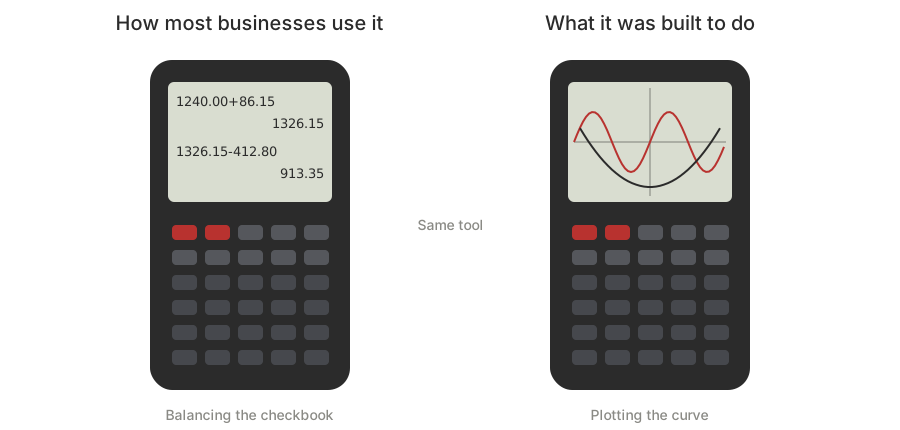
That is roughly where most businesses are with AI. They own a machine that can do far more than balance a checkbook, and they use it to balance the checkbook: quickly, accurately and every day.
Frequency isn't the measure. You can use a graphing calculator every day for ten years and never draw a curve.
Multiplication
An agent is an AI tool that does more than answer. It takes steps on its own: it reads what comes in, decides what to do with it, does it and passes the result on.
Give a newcomer five agents and he pictures five assistants doing five separate jobs. One handles the inbox, one does the books, one chases invoices, one watches inventory and one writes the weekly report. That is still arithmetic: five jobs, done faster.
Arranged well, each agent does its own job and also works with the other four. The agent chasing invoices notices a customer paying later each month and tells the one that writes quotes. The one watching inventory sees a supplier slip and tells the one answering customers, before a single customer has to ask. Nobody was assigned to connect those dots. The network connects them.
That is the difference. Same tools, same subscription. Multiplication instead of arithmetic.
A minute on the math
Let's spend a minute on some math, because it explains why this matters more as a business grows.
Value follows connections, not members. Robert Metcalfe, who co-invented Ethernet, observed that the value of a network grows with the number of connections between its members, not the number of members. Every pair of members is a possible connection, so the count is:
connections = n × (n − 1) ÷ 2
| Agents | Working alone | Connections |
|---|---|---|
| 5 | 5 jobs | 10 |
| 10 | 10 jobs | 45 |
| 20 | 20 jobs | 190 |
Double the agents from 10 to 20 and the work doubles. The connections more than quadruple.
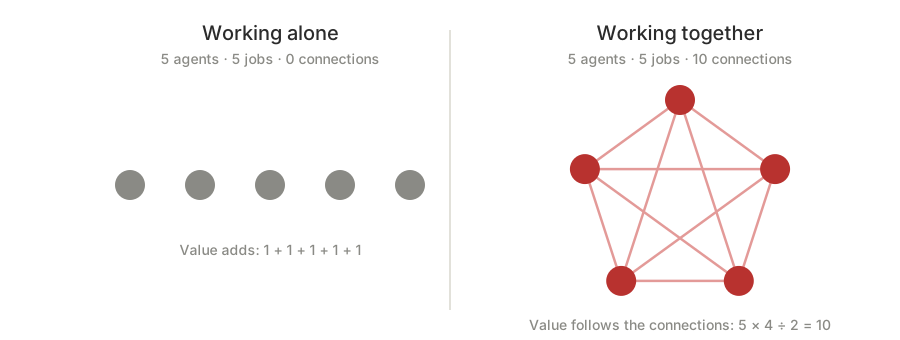
Not every connection is worth something. Some pairs of agents have nothing to say to each other, and the law has fair critics who argue it overstates the value of large networks. The exact number isn't the point. The shape is: jobs grow in a straight line, and connections grow much faster. A business that counts only jobs is measuring the wrong thing.
A useful rule of thumb: if your agents don't talk to each other, you bought a calculator and you're using it to add.
What it looks like in a business
Two illustrative examples. They are composites written for this paper, not accounts of specific clients, and they combine patterns we see often. Neither business is unusual, which is the point.
A specialty distributor
A distributor with a few thousand customers and thin margins set up five agents: one reads incoming orders from email and enters them, one tracks inventory and supplier shipments, one prepares quotes, one manages collections and one answers routine customer questions.
As five separate tools, each saves time. Orders get entered faster. Quotes go out the same day.
Connected, they catch things nobody was assigned to catch:
- Slow payers. The collections agent sees a large customer's payments drift from 30 days to 55. It tells the quoting agent, which stops offering that customer extended terms, and it flags the account to the owner before the receivable becomes a write-off.
- Late shipments. The inventory agent learns a supplier's container is two weeks late. The customer-service agent writes to every customer with an affected order before any of them call, and the quoting agent stops promising that ship date.
- Quiet losses. The order agent notices that one customer has stopped ordering a product line it bought every month for three years. It goes into the owner's weekly summary, which is the first anyone hears of a competitor's visit.
None of these is dramatic on its own. Each is a problem that used to be found late, by accident or not at all.
A home-services company
A residential heating and plumbing company with several dozen technicians runs agents for booking calls, scheduling and routing, ordering parts, following up after each job and watching online reviews.
- The next job. A technician's notes mention a fifteen-year-old water heater. The follow-up agent schedules a replacement quote for the fall, instead of waiting for it to fail on a holiday weekend.
- The weak link. The review agent sees three complaints in a month about one crew arriving late. The scheduling agent stops booking that crew into tight morning windows while a manager looks into it.
- The surge. A cold snap is forecast. The booking agent expects a wave of no-heat calls, parts go out a day early and the schedule holds room for emergencies.
The owner didn't buy more software. He arranged what he had so that what one part of the business learns reaches the others while it still matters.
The catch
Connections multiply mistakes as fast as they multiply results.
A chatbot that gets something wrong produces one wrong answer, and a person usually catches it. An agent that gets something wrong passes it on. If the quoting agent misreads a price list, the error can reach the invoices, the customer emails and the weekly summary before anyone looks. Ten agents have 45 paths for a mistake to travel. Twenty have 190.
A badly designed network doesn't just fail to help. It compounds errors quietly, confidently and at the speed of software.
So the hard part isn't the tools. Anyone can buy those, and most businesses already have. The hard part is the design: which agents should talk to each other, what they are allowed to pass on, where a person checks the work, and what happens when one of them is wrong. That design is specific to each business, and it is most of the work.
Why no one talks about this
If the difference is this large, why do most businesses stop at arithmetic? Partly because arithmetic is what gets sold.
Most AI tools are priced per seat: so much per person per month. That rewards adding users, not connecting them. A demo has a few minutes to impress, so it shows one agent doing one task; a network doesn't fit in a video. And most AI training teaches individuals to write better prompts, which makes each person better at arithmetic.
None of this is bad faith. The people selling the tools are paid by the seat, and nobody is paid by the connection. So the businesses buying them hear a great deal about what each tool can do and very little about what the tools could do together.
Objections
"We already use AI every day." I believe it. Frequency isn't the measure. The question is whether anything one tool learns ever reaches another without a person carrying it there.
"Our people will figure it out." They will get better at arithmetic. Each person learns to ask better questions of their own tool. A network is a decision about how the business works, and no single employee is in a position to make it.
"Isn't this just automation?" Older automation follows fixed rules: when this happens, do that. It is reliable, and it breaks the moment something unexpected arrives. Agents can read a messy email, judge what matters in it and decide who else needs to know. That judgment is what makes the connections worth having. The best networks use both: ordinary software for the math and the records, agents for the reading and the judgment calls.
"More agents means more risk." It does, and that is the right instinct. Connections without design mean more risk. That is an argument for designing the network, not for avoiding one.
"We'll wait until the tools mature." Waiting is a real choice, and the tools will keep getting better and cheaper. But the tools aren't the hard part. Knowing how the parts of your business should connect is work no vendor will do for you, and it takes just as long whenever you start.
Questions worth asking
Most owners can answer these in a few minutes. The answers tend to show quickly whether the business is doing arithmetic or multiplication.
About use
- How many of our AI uses start with a person typing a question and end with a person copying the answer somewhere else?
- If every AI subscription we pay for disappeared tomorrow, which process would actually change?
- Is there anywhere the output of one AI tool becomes the input of another without a person in between?
About connections
- What does one part of our business learn that another part needs, and how long does it take to get there?
- Which problems do we usually find late, by accident or from a customer?
About risk
- If one of our AI tools is wrong, how far does the mistake travel before a person sees it?
- Who is responsible for how our AI tools work together, as opposed to each tool on its own?
- Are we paying for seats, or for a system?
If the honest answers to the first three are "almost all of them," "none" and "nowhere," you are doing arithmetic. Most businesses are. It is a fine place to start and a poor place to stay.
An invitation
This paper is a perspective, not a prescription. Which connections matter depends on what the business does, where its information lives, and which mistakes it can afford and which it can't. Those answers don't come from a paper; they come from a conversation.
If you haven't gone beyond individual tools, the most valuable time is before you add more of them. If you already have agents running, the question is simpler: what does each one know that the others don't, and what would happen if they told each other?
I should be clear that we design and build these systems for clients, so I have an interest in the conversation. I'd welcome the chance to talk it through with you, whether or not it leads anywhere.